

Learn how to configure Electronic Signature global settings
Before you start, log in as a user with the Jira Administrators global permission.
All the settings described in this chapter will be applied globally, to all screens where the Electronic Signature custom field has been added.
To open the Electronic Signature global configuration page:

The configuration page appears.
Here’s an overview of all available settings. Scroll down to read their descriptions.

Click on the title to see more information:
Remember to save the changes every time you change the configuration.
When this option is enabled, the custom field is automatically populated with the username of the currently logged in user.
Credentials of the currently logged in user being auto-populated in the Electronic Signature custom field:

Enabling this option makes signature optional on the screens. This means that even if a user doesn’t provide any credentials, the issue will pass the transition.
By enabling this option you’ll make the Username field case-sensitive.
Error message displayed after a user provides a username that isn’t case-sensitive:

Enable this option to display only the last snapshot under Signatures in the issue Activity section.
Signatures tab on the issue view when only the last snapshot is displayed:

Learn more in the PDF snapshots chapter.
Selecting this option allows only the currently logged in user to sign off the issue.
Error message displayed after a user provides other credentials:

Select this option to hide the following hint text displayed by default under the Electronic Signature custom field: Enter valid credentials to sign this record. This is in compliance with the FDA regulation CFR part 11.
Electronic Signature custom field without field description:

Select this option to add PDF snapshots as attachments on the Customer portal. A link to the PDF will also be displayed as an external comment.
PDF snapshot attached to a request on the Customer portal:
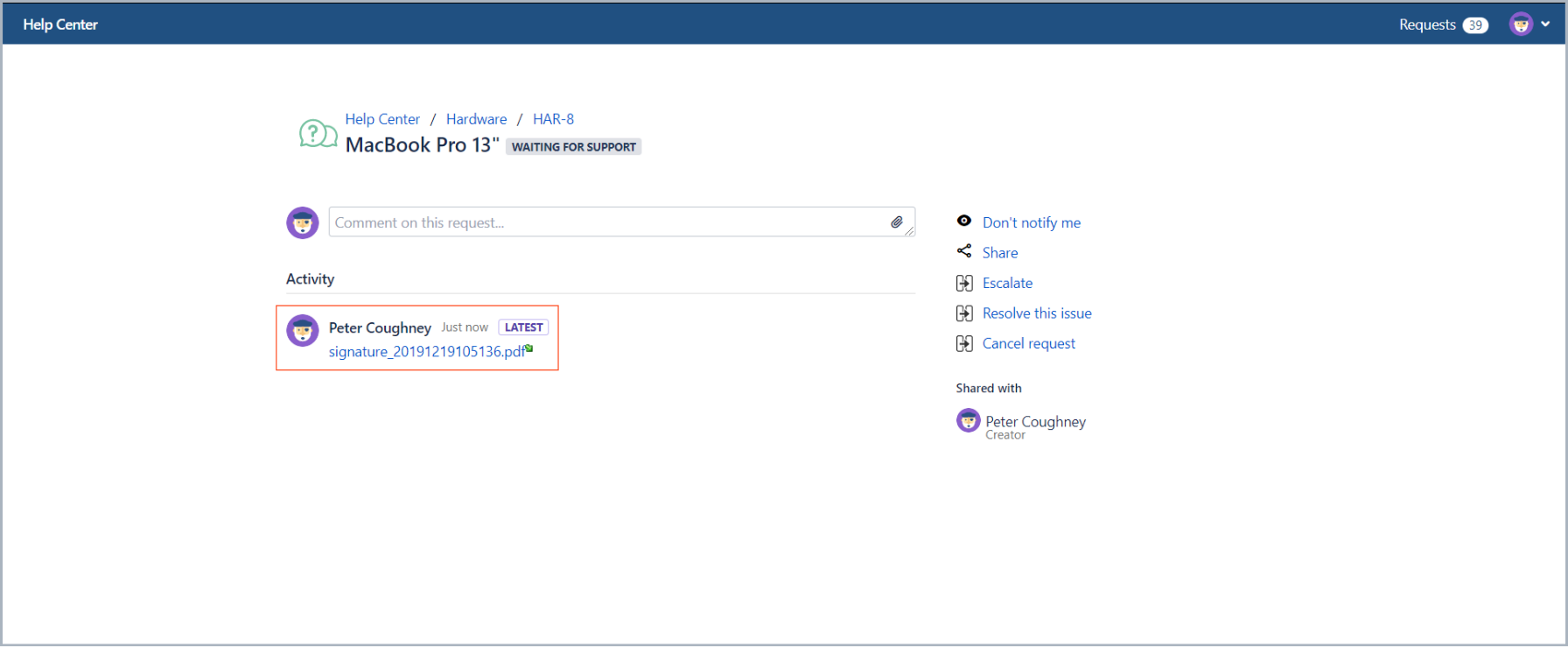
Learn more in the PDF snapshots chapter.
Set the number of failed login attempts that will cause a signature to be locked. The default is zero (0) which means that the signature will never be locked.
To unlock the signature, go to Invalid attempts logs and click Clear history.
Select fields that you don’t want to show on the exported PDF.
Hold the Ctrl key and click the items in the list to select more than one of them.
Learn more in the PDF snapshots chapter.
Choose roles to narrow down the group of users who are allowed to sign off issues and make transitions.
If no roles are selected, the validation will be ignored. Otherwise, the user needs to be assigned to any of the selected roles (in at least one project) to pass the validation.
Error message displayed when a user who is not assigned to any of the selected roles tries to provide their credentials:

To limit the number of users allowed to sign off an issue even more, go to Custom field settings.
Select this option to display how many signatures are required to authorize a transition and how many have already been given. The numbers will be displayed in a dedicated panel on the issue view. You can specify the number of required signatures in the next option.
Required Signature Panel only shows the information about the number of unique users who provided their credentials. It doesn’t prevent the progress of the issue, even if not all required signatures are given. In order to block an issue transition until a signature is given, you can use the Electronic Signature validator.
Required Signature Panel on the issue view:

Type in the number of signatures that are necessary to sign off an issue. In order to display it, select Enable Required Signature Panel right above this option.
If more than one signature is required, all approvers can provide their credentials in one custom field. After one signature passes the validation (so that the issue gets created, edited, or transitioned successfully), the custom field is being cleared and another user may safely provide their credentials. The only information that’s being saved by the app is that a certain user signed the issue (successfully or not). All the details are displayed in the Signatures section on the issue view.
Number of Minimal required signatures on the issue view:

Choose this option to turn the Username field into a User Picker (single user). This setting makes it easier to sign off issues while using Jira on mobile devices.
Only users allowed to sign off this particular issue will be displayed in the drop-down list.
Electronic Signature custom field as a User Picker:

If you can’t find the answer you need in our documentation, raise
a support request.
Include as much information as possible to help our support team resolve your issue faster.

 Apps documentation